



Rehabilitation of the Salesas Convent in Pamplona is a minimalistic intervention with dual heritage and environmental objectives
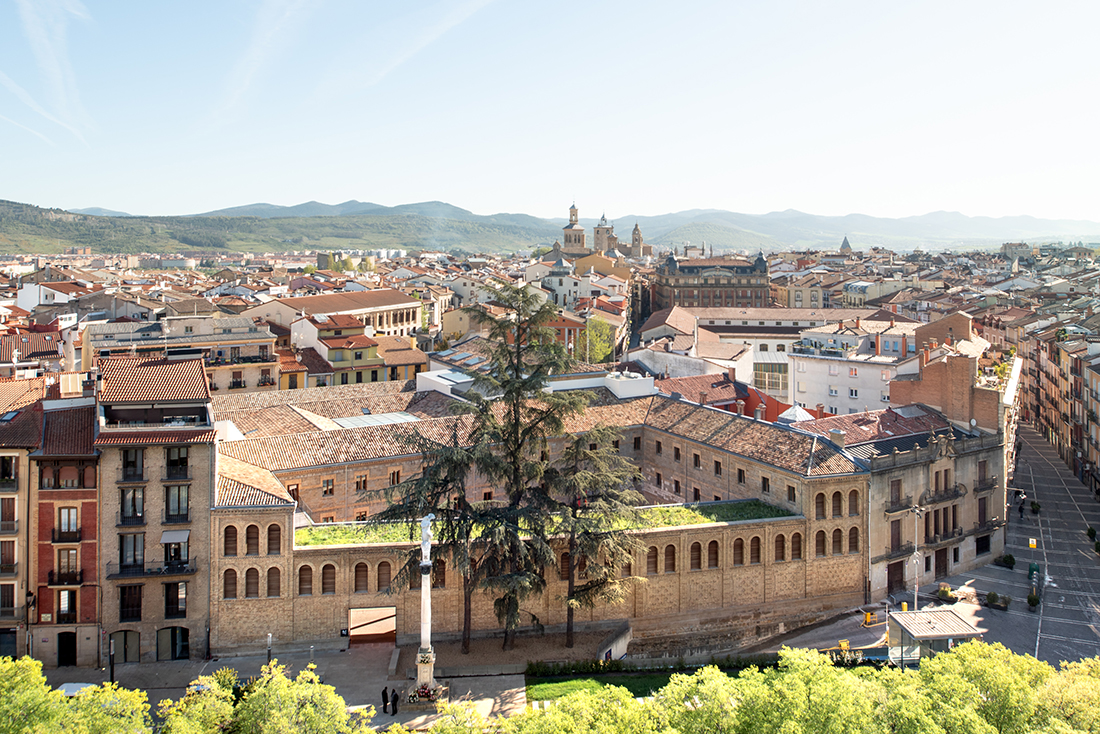
On the western edge of Pamplona’s old town stood the Salesas Convent. In 2010, the Greater Pamplona Community (Mancomunidad de la comarca de Pamplona MCP) was able to acquire the building, which had been vacant since 2003. The intention of the institution was to join all of their employees, who had previously been spread across several buildings, in one new administrative facility. Instead of constructing a new building on the outskirts of the city, it was decided to convert and renovate this old building. The competition was won by a team of the three architecture offices Matos Castillo, Álvarez Sala and Rueda Pizarro. The local architects Tabuenca & Leache and Javier Urdaci collaborated for the management of the construction site. The architectural intervention was intended to be as carefully as possible. The monastery, parts of which are listed as a historic monument, was retained in its basic structure with its three inner courtyards. However, the entrance was relocated to the west side: the former rear monastery garden now serves as a forecourt.
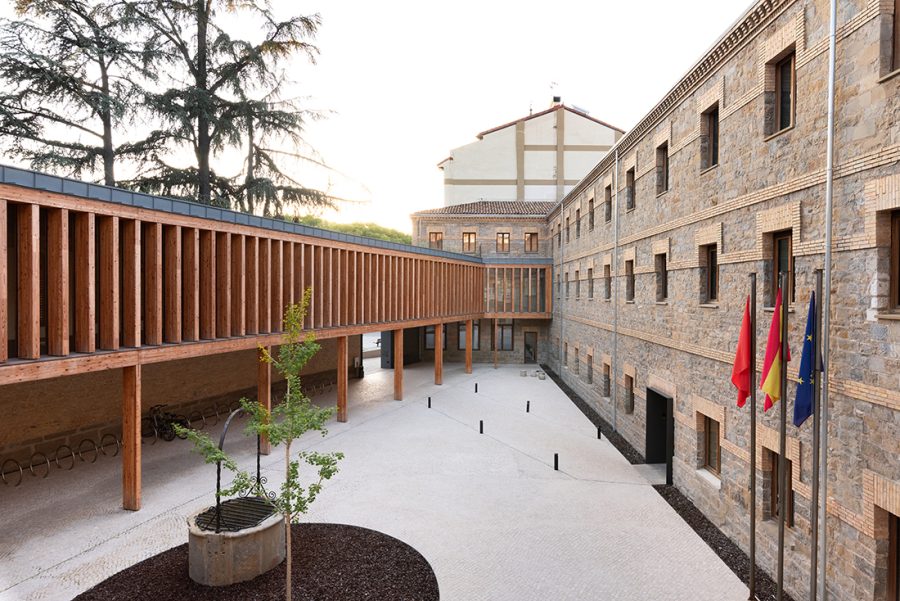
Rehabilitation of the Salesas Convent – entrance courtyard with new addition. ©Ana Matos
The church was converted into an event and meeting space and named after the monastery’s architect, F. Ansoleaga. For the majority of the floor space, the new use required the conversion of the monastery’s small-scale room structure into large open-plan office spaces. Where possible, the preserved old building walls were used as the vertical supporting structure. The exceptions are the interior walls around two of the inner courtyards: here, in consultation with the monument protection authorities and while retaining the historical dimensions, new reinforced concrete walls were erected.
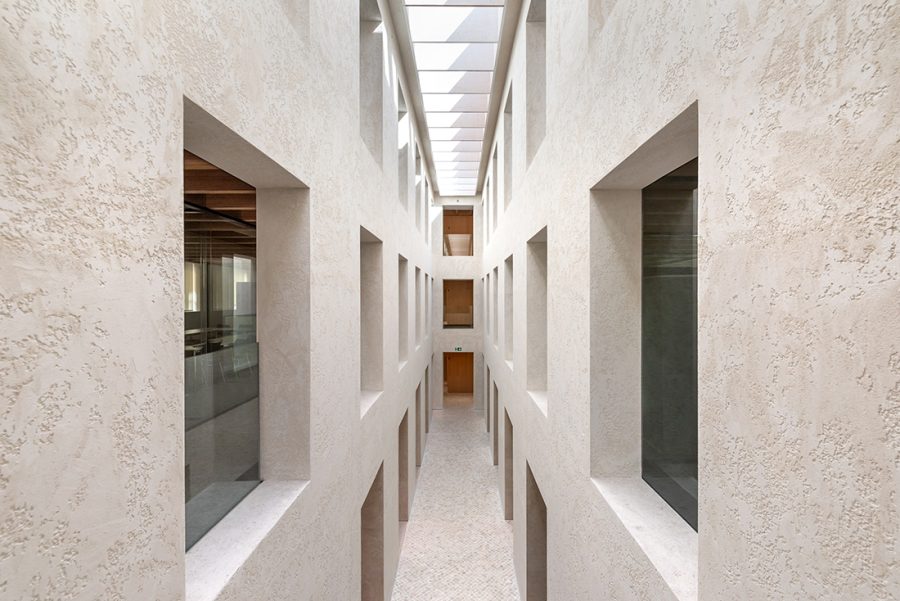
Rehabilitation of the Salesas Convent – interior courtyard. ©Ana Matos
A construction consisting of vertical micro-laminated wooden trusses and horizontal CLT panels was chosen for the floor slabs. The height of the beams is kept constant at 44 cm, with only the clear distances being adapted to the respective static situation. The visible timber construction, together with the textured plaster, harmoniously references the old building elements. All technical instalations are accommodated in a raised floor. This creates a visually uncluttered interior.
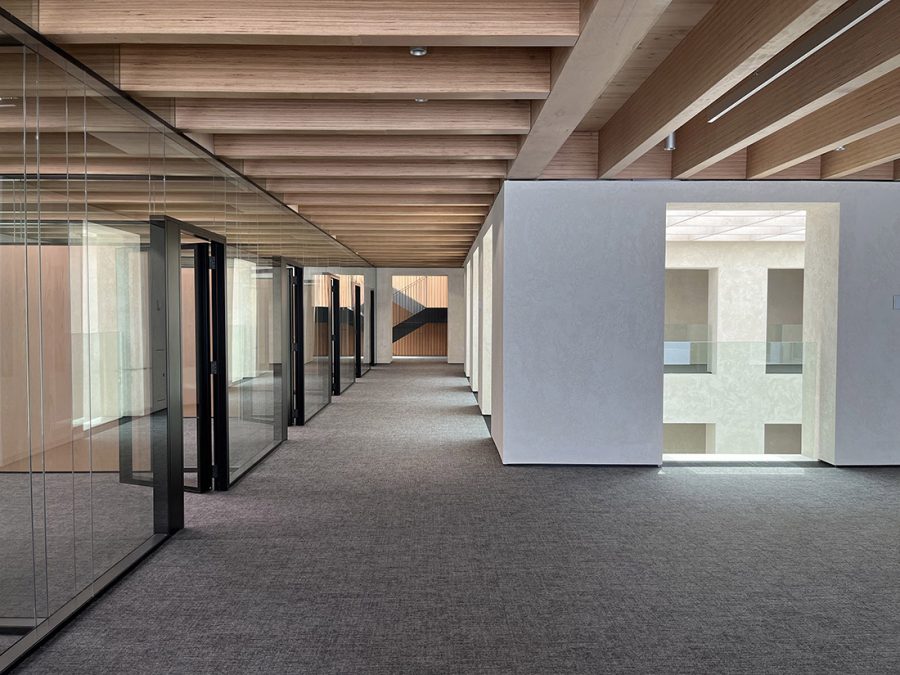
Rehabilitation of the Salesas Convent – office spaces. ©Ana Matos
Extensive energy efficiency measures were implemented in the overall planning. The use of geothermal energy and compliance with contemporary insulation standards enabled the NZEB (Nearly Zero Energy Building) standard to be achieved. In view of the public sector’s role as a role model, both the planning process and the finished building were intended to serve as a showcase project for the sustainable use of listed buildings.
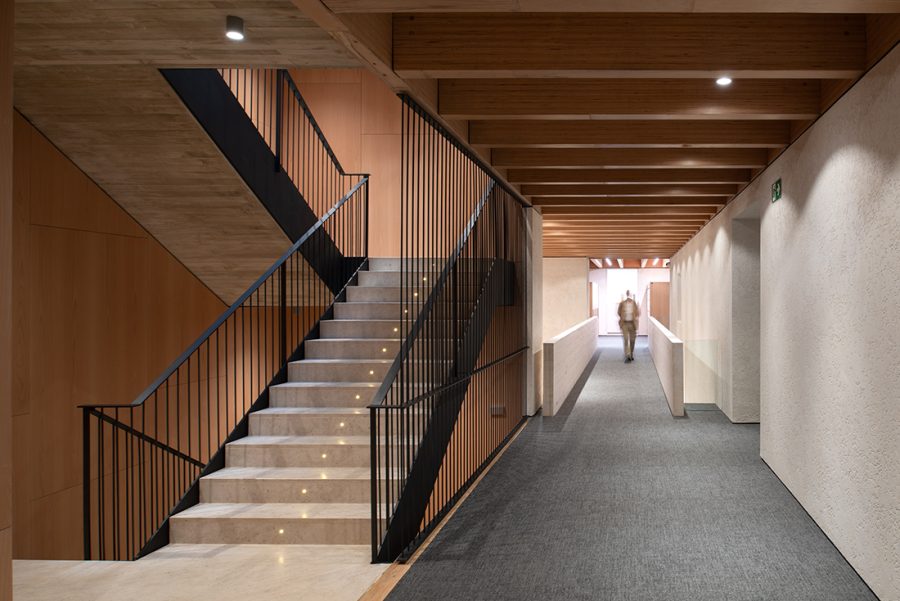
Rehabilitation of the Salesas Convent view – circulation areas. ©Ana Matos
Text by: Bernd Nitsch, GA BILBAO
*First image: Rehabilitation of the Salesas Convent – view on the entire complex with entry situation. ©Ana Matos
